Core Mantra | Its Essential Purpose

Recently, a good part of our interactive group Mantra Master Class sessions on Zoom was dedicated to our Core Mantra Practice, which we’ve all been exploring together.
Here are some of the teachings that have been shared. Students also have access to tutorials, conversations with students, and posts on my own present-day discoveries with the Core Mantra Practice.
Join our Mantra Master Class Series
What Is the Core Mantra Actually For?
The idea of a core mantra has been central to the Yoga of Sound for many years. Yet as our practice develops—and as we ourselves change—it is valuable to return periodically to a very basic question:
What is the core mantra actually for?
Over time, we can easily begin to use a mantra for many different purposes. We may turn to it because we want peace, grounding, emotional regulation, protection, reassurance, healing, or clarity.
All of these may be legitimate benefits of mantra practice. But they are not, in themselves, the essential purpose of the core mantra.
At its heart, the core mantra is about relationship with ultimate reality.
A Core Within a Community of Mantras
Those of us who have practiced mantra for some time rarely have only one mantra. We develop what I call a community of mantras.
Different mantras may serve different purposes. Some are associated with particular deities, qualities, needs, traditions, or periods of our lives. There is nothing inherently wrong with having many mantras.
But this raises another question:
What lies at the center of them all?
What is the mantra to which we return when we are not trying to solve a particular problem or accomplish a particular spiritual task?
This is the role of the core mantra. Amid our community of mantras, it gives us a center.
Sound and Meaning
The core mantra is a mantra whose sound and meaning help us draw close to ultimate reality.
Sometimes we are strongly in our thinking mind. At such times, the meaning of the mantra can orient consciousness toward the reality with which we seek relationship.
At other times, we may be strongly emotional. We may not need—or even be able—to think our way toward that relationship. Then the sound itself can carry us.
Sound and meaning therefore provide two complementary pathways. Both help us bridge the apparent distance between ourselves and ultimate reality.
The Mantra That Was Right Then May Not Be Right Now
There is another important dimension to core mantra practice: we change.
A core mantra that was entirely appropriate twelve years ago may no longer serve us in quite the same way today. Our priorities may have changed. Our spiritual life may have developed. Even the form through which we experience ultimate reality may have changed.
Someone once deeply oriented toward Shiva, for example, may discover that the feminine face of ultimate reality has become increasingly important through Shakti, Lalita, the Lalita Sahasranama, or Meru Upasana.
This does not mean the earlier mantra was wrong.
The deeper fidelity is not necessarily to the particular mantra. The deeper fidelity is to the relationship the mantra exists to serve.
And so it can be useful to ask:
What expression of ultimate reality is genuinely speaking to me now?
Not what once held significance. Not what I think I should be practicing. But what relationship is alive now?
Relationship Before Result
This becomes particularly important when something beautiful happens in practice.
We may experience spaciousness or quiet. We may feel grounded or loved. We may even experience something as intimate as being held.
Such experiences can be deeply significant.
But a benefit of the core mantra is not necessarily the purpose of the core mantra.
Suppose I experience being held while repeating my mantra. The next time I practice, I naturally want that experience again. Without realizing it, I may have changed the purpose of the practice.
Instead of:
I am using this mantra to enter relationship with ultimate reality.
It has become:
I am using this mantra because I want to feel held.
Those are not the same thing.
The mantra was never intended to manufacture a particular feeling. The feeling was something that happened within the relationship. We can appreciate such experiences without demanding their return.
This is why I describe the core mantra as being about relationship before result.
Peace may come. Spaciousness may come. The mind may settle. Emotional regulation may occur. Or none of those things may happen on a particular day.
The deeper question remains:
Am I entering the relationship?
Many Practices, One Center
Our spiritual lives can become very wide. We may be working with many mantras, sacred texts, rituals, contemplative methods, courses, and practices.
All of this richness can be valuable. But too many choices can also work against depth.
The core mantra provides an anchor.
Whatever else we practice, there is one thing to which we return. The other practices do not have to disappear. They simply no longer have to compete for the center.
Many practices. One center.
The core mantra helps us go deep without requiring us to become narrow.
A Question for Your Own Practice
If you are working with a core mantra, consider asking yourself:
Why is this my core mantra?
Not simply: What do I hope it will make me feel?
Not: What problem do I want it to solve?
Instead:
What relationship does this mantra embody for me?
Do its sound and meaning still draw me toward ultimate reality in a way that feels alive and fulfilling?
Does it reflect the spiritual relationship that is actually central to my life now?
If it does, there may be no reason to change anything. Stay with it. Allow the relationship to deepen.
And perhaps, over time, another question becomes possible:
What does remaining with this relationship reveal about me?
Discover more with our Mantra Master Class Series

Author-Educator and Musician-Producer

Russill Paul
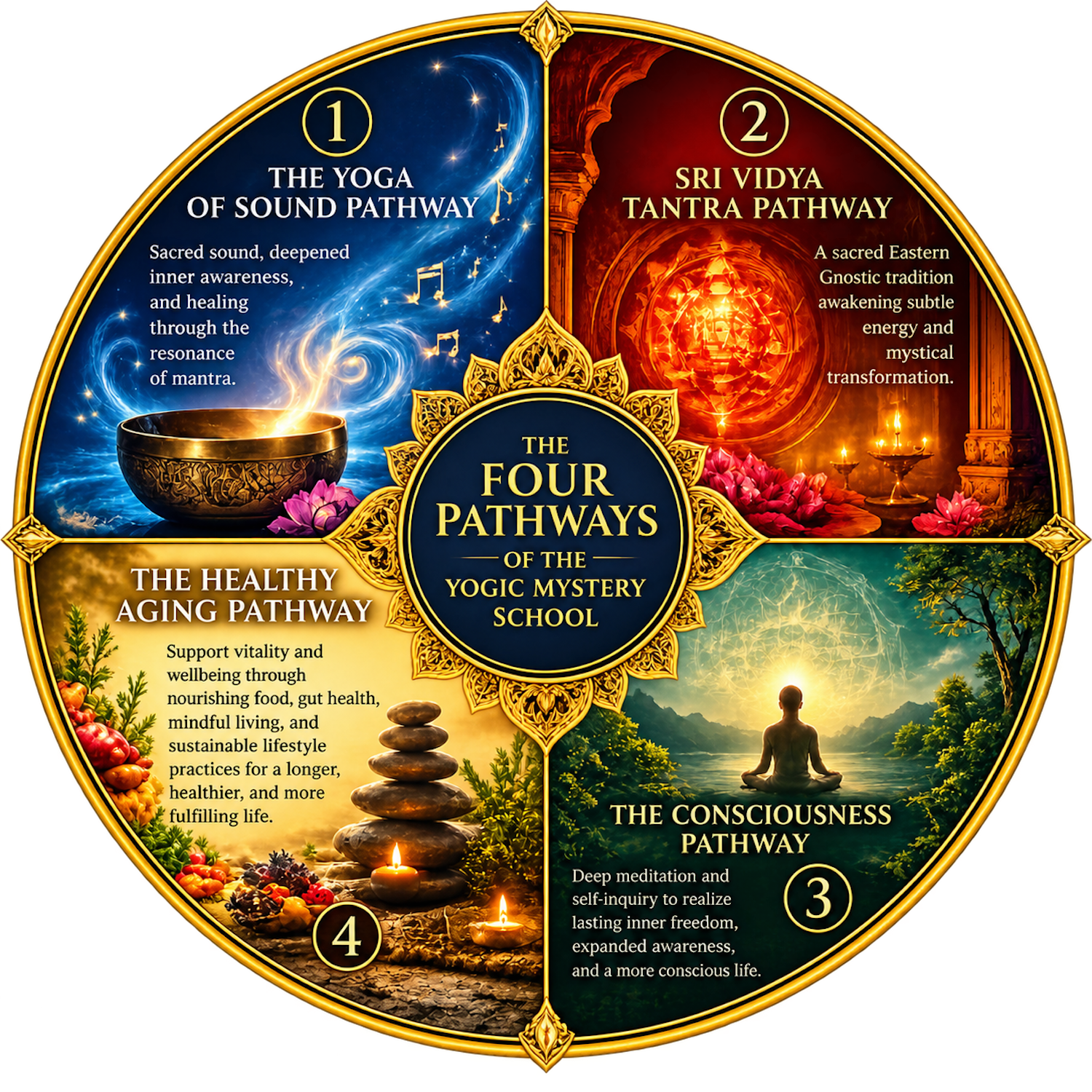
Russill Paul is the author of The Yoga of Sound: Tapping The Hidden Power of Music and Chant and co-founder of Yogic Mystery School with his wife, Asha, an integrative health coach. He teaches internationally and online. They live in Austin, Texas.
Our New Cooking Club!
Develop a sacred kitchen as you also learn healthy recipes and healthy cooking methods.

Asha Paul is an educator, author, coach, and passionate cook who is deeply committed to promoting health and well-being. Passionate about helping others feel their best and age gracefully, she shares her knowledge through online teaching. Asha resides in Austin, Texas, with her husband, Russill.