The Functional Value of Mantra Types
Most people think of mantra as a single practice—a sacred phrase repeated in meditation, prayer, or yoga. Yet within the authentic Yoga of Sound tradition, mantra is far more nuanced. Just as different medicines serve different purposes, different mantras awaken different dimensions of our being.
Three Paths, Three Functions
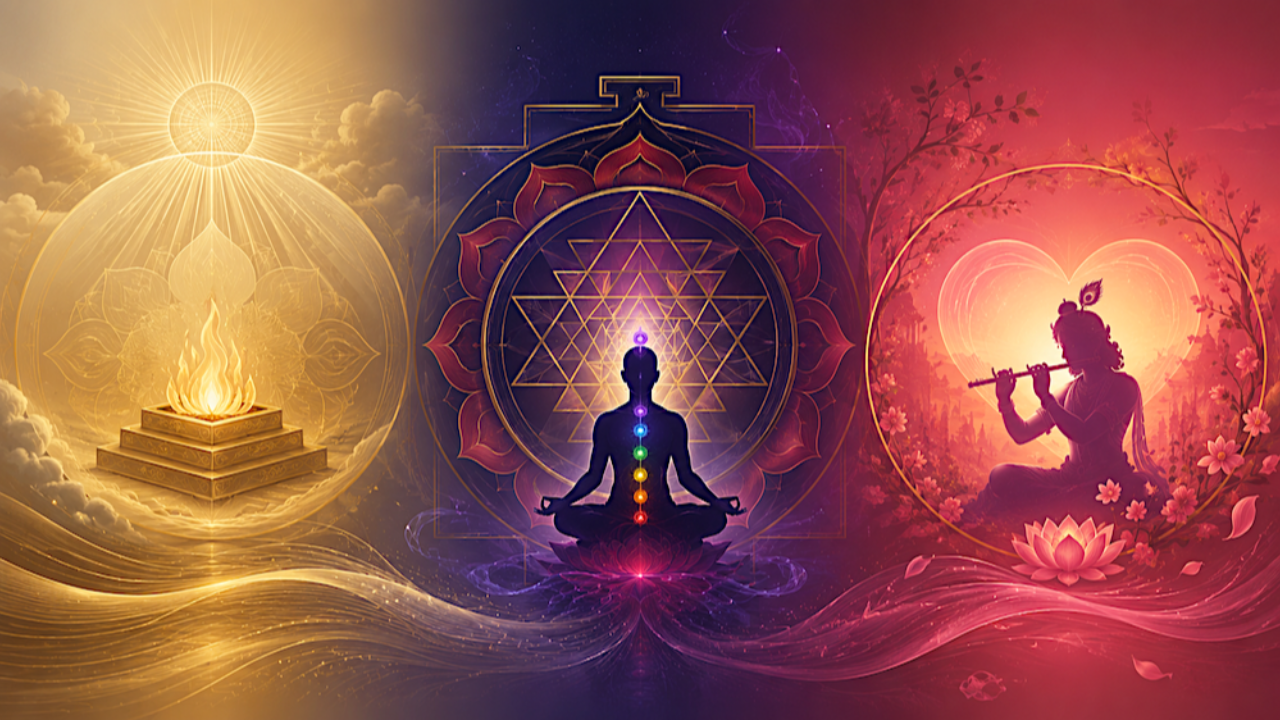
In the Yogic Mystery School, we study three primary streams of mantra: Vedic, Tantric, and Bhakti. Each has its own purpose, method, and transformational effect. Learning to recognize these distinctions can completely change the way you experience mantra practice.
Vedic Mantras: Aligning with Higher Consciousness
Vedic mantras are among humanity's oldest sacred sounds. Traditionally chanted with precise tonal patterns, they are designed to align the individual with cosmic intelligence and universal order.
Rather than expressing emotion, Vedic mantras cultivate clarity, steadiness, and higher awareness. They invite us beyond the personal mind into a state of profound inner alignment. Their power lies not only in their words but in their exact pronunciation, rhythm, and tonal inflections, preserved for thousands of years through oral transmission.
When practiced correctly, Vedic mantra becomes an instrument for awakening our highest Self.
Tantric Mantras: Awakening Sacred Energy
Tantric mantras serve a different function. Their purpose is not simply to elevate consciousness but to awaken and direct Shakti—the dynamic spiritual energy that animates all life.
These mantras become vehicles for transformation, helping us access vitality, creativity, protection, healing, wisdom, and the living presence of specific divine archetypes.
In Tantra, sound is not merely symbolic. Sound is energy. Every syllable carries a vibrational intelligence capable of reshaping consciousness from within.
Bhakti Mantras: Opening the Heart
Bhakti mantras speak directly to the heart.
Rather than emphasizing transcendence or energetic activation, they cultivate relationship—with the Divine, with beauty, and ultimately with our own deepest nature.
These devotional mantras soften the places within us that have become hardened through life's disappointments. They awaken love, gratitude, surrender, joy, and longing for the sacred. Their melodies often draw from the rich musical tradition of the Indian ragas, making them especially accessible through singing.
For many practitioners, Bhakti mantra becomes one of the most natural and joyful expressions of spiritual practice.
The Way We Chant Matters
One of the greatest misconceptions about mantra is that repetition alone produces its full effect.
Certainly, any sincere repetition has value. But traditional yogic science teaches something far more profound.
How we chant influences what the mantra does.
Pronunciation is one essential component. Pitch is another. Rhythm, breath, resonance, and intention all contribute to the functional power of a mantra.
For example, classical Vedic chanting employs a precise three-tone system that has been carefully preserved for millennia. Devotional mantras, on the other hand, often unfold through melodic ragas that evoke distinct emotional and spiritual qualities. Tantric mantra introduces yet another dimension, where sound becomes a living current of transformative energy.
These are not merely stylistic differences. They are functional technologies of consciousness.
Beyond Memorization
Our goal is not simply to teach more mantras.
Our aim is to help you understand why a mantra works, when to use it, and how to bring forth its deepest potential.
As you begin listening to different examples, notice your own experience. Which mantras create stillness? Which awaken energy? Which open your heart?
Rather than analyzing them intellectually, pay attention to how each one affects your body, breath, emotions, and awareness. This direct experience becomes one of your greatest teachers.
Experience the Difference
Reading about these three streams is one thing.
Hearing them is another.
Below are several examples representing Vedic, Tantric, and Bhakti mantra. As you listen, don't worry about identifying them correctly. Instead, notice your own inner response.
Which sounds create stillness?
Which awaken energy?
Which open your heart?
Pay attention to your breath, emotions, and awareness. Your own experience will begin teaching you the functional language of mantra.
A New Journey into the Yoga of Sound
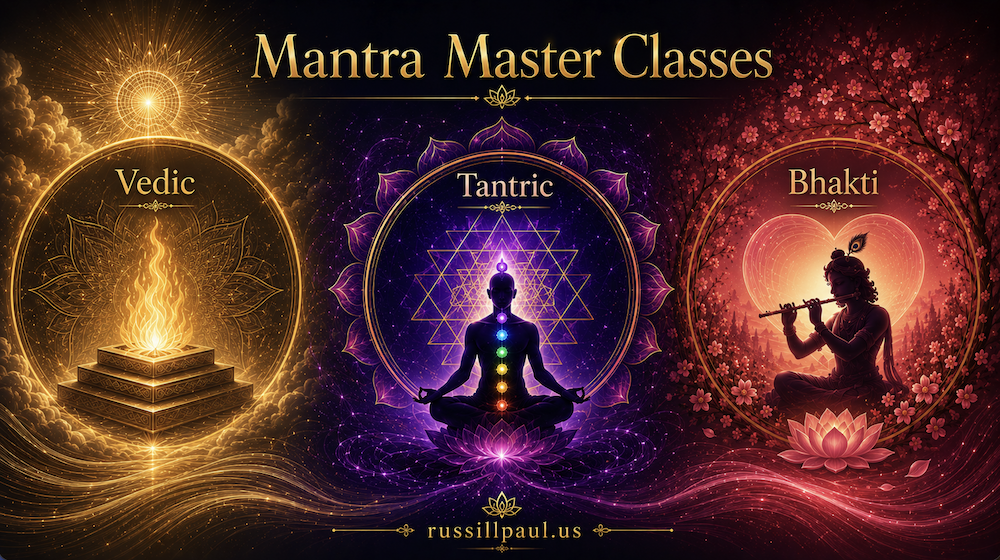
Our new Mantra Master Classes train you in all three streams of mantra—Vedic, Tantric, and Bhakti—through a practical, experiential approach.
You'll discover how to chant with greater authenticity, precision, and feeling so that the functional power of mantra becomes a living reality in your own practice.
The ancient masters understood that sound has the capacity to transform consciousness. Vedic mantras align us with higher consciousness. Tantric mantras awaken sacred energy (shakti). Bhakti mantras soften the heart and fulfill the soul's deepest longing.
While repeating mantras in any way will always have some effect, learning to chant them in specific traditional ways can dramatically amplify those effects. This is the purpose of our Mantra Master Classes.
Pronunciation is one component of our process. Pitch is another. Traditional Vedic mantras, for example, employ a three-tone system, while devotional mantras often draw from the rich melodic language of the ragas.
How do we bring out the unique flavor of each mantra? How do we invite the living presence behind these sacred sounds into our consciousness?
Join The All-New Mantra Master Classes
Train in all three types: Vedic, Tantric, Bhakti
Author-Educator and Musician-Producer

Russill Paul
Russill Paul is the author of The Yoga of Sound: Tapping The Hidden Power of Music and Chant and co-founder of Yogic Mystery School with his wife, Asha, an integrative health coach. He teaches internationally and online. They live in Austin, Texas.
Our New Cooking Club!
Develop a sacred kitchen as you also learn healthy recipes and healthy cooking methods.

Asha Paul is an educator, author, coach, and passionate cook who is deeply committed to promoting health and well-being. Passionate about helping others feel their best and age gracefully, she shares her knowledge through online teaching. Asha resides in Austin, Texas, with her husband, Russill.